
Choosing a seasonal RV site in Ontario starts with how you plan to use it: repeat weekends, longer recreational stays or occasional family visits. Compare the actual lot, permitted camping dates, travel routine and full cost before committing. This guide covers questions to ask private campgrounds and provincial parks, with Maitland Shores in Dunnville, Haldimand County, as one option to investigate. A seasonal site is a recreational base governed by an agreement, not permanent housing.
Key Takeaways
- Match the selected lot, hookups and access route to your RV and other equipment.
- Compare the total seasonal cost, permitted camping dates, storage terms and expected travel routine.
- Review each park’s application, deposit, renewal, pet and site-improvement rules before committing.
- Confirm boat launch, dockage and ATV permissions separately from the campsite.
- Use a tour or trial stay to assess suitability; neither guarantees seasonal availability.
How to Compare Seasonal Campgrounds in Ontario
The right seasonal campground depends on your equipment, budget and expected visits. Compare specific offers rather than assuming a private resort or provincial park is automatically better. Consider whether the return journey fits the weekends you expect to use, including towing, breaks and arrival arrangements. A short stay can help test that routine before a longer commitment; our Cambridge-to-Dunnville seasonal-site decision guide shows how to structure a trial visit without treating it as a seasonal reservation.
What a Seasonal Site Agreement Means
A seasonal site lets you plan repeated camping visits within the park’s operating season. Read the agreement for permitted use, guest access, renewals and storage terms. A summer base is not land ownership or permission for year-round residence.
Geography Matters: Lake Erie vs. Northern Ontario
Location affects both your stay and the journey there. Compare the setting, operating dates and site services of each campground, rather than assuming every Southern Ontario park offers the same season or travel time. For repeated trips from Hamilton, Burlington or the GTA, check your full route, towing restrictions and current traffic. Being near a river or lake does not guarantee beach access, swimming suitability or a boat launch. Consider which of these features matters to your plans:
- Waterfront Access: Direct entry to Lake Erie or the Grand River for boating and fishing.
- Mature Forest Cover: Natural shade that keeps your site cool during July heatwaves.
- Strategic Elevation: Sites that offer a fresh breeze and a clear view of the horizon.
Seasonal campgrounds in Ontario balance these natural wonders with modern comforts. It is about finding that perfect spot where the land meets the water and the city feels a world away.
Essential Features to Look for in a Seasonal RV Resort
Choose facilities around your actual camping needs. Give the office your RV’s overall dimensions, slide-out requirements, electrical needs and any additional vehicle or boat-trailer details. Ask how the selected lot is accessed, which services it has, where equipment may be parked and how maintenance issues are reported. Check the written terms alongside the tour rather than relying on a general amenities list.
Ask the office about utility capacity, maintenance reporting, emergency contacts and access arrangements. Do not assume a gate or staff presence guarantees security for an unattended RV. Review your insurance coverage and the park’s written responsibilities before leaving your setup between visits.
Full Hookups and Modern Infrastructure
Match the site’s utilities to your RV and expected use. Confirm the electrical connection available on the selected lot, water and sewer arrangements, metering and any separate charges. A general description of 30- or 50-amp options does not establish the service on every site or guarantee that all appliances can run together. Ask about connection locations, site drainage and road conditions, and inspect the lot where possible; no surface guarantees a dry patio in every storm.
Beyond the Basics: Specialized Amenities
Compare recreation against the activities you actually plan to use, whether you choose a private campground or a public park. For boating, review boat launch information and ask about permission, hours, vessel suitability, trailer parking and separate fees. A private launch does not guarantee immediate access or a reserved marina slip. For other activities, check the following before booking:
- ATV access: Check the permitted riding areas, office approval, registration, waivers and any separate fees. Do not assume you may ride through campground roads or pedestrian areas to reach a trail. Review Maitland Shores’ ATV access information before bringing a vehicle.
- Hunting permission: A seasonal campsite does not establish hunting access. At Maitland Shores, hunting on the premises is prohibited unless expressly authorized in writing by management and permitted by applicable law. Review the hunting and weapons rules before making plans.
- Social activities: Ask which gathering spaces and activities are currently offered, whether participation has conditions or fees, and how schedules are confirmed. At Maitland Shores, check the events calendar rather than assuming bingo, potlucks or dances are scheduled.
Compare the usable lot with your RV, slide-outs, parking needs and permitted outdoor setup. Space for a structure does not mean permission to build it. At Maitland Shores, obtain prior written approval for site alterations and any required permits before work begins; confirm proposed additions before buying materials.
Provincial Parks vs. Private Resorts: Which is Right for You?
Compare the actual site and contract rather than assuming a private resort or provincial park is automatically better. The Ontario Parks Seasonal Campsite Program is one option to research alongside private seasonal campgrounds. Check each park’s services, permitted use, application process, season dates and rules against your needs.
The Flexibility of Private Site Management
Ask about decks, sheds, gardens and other site modifications before buying materials or arranging work. Written park approval and any applicable permits may be required, and restrictions differ between properties. A seasonal agreement does not mean you own the land or can alter it freely. If social activities matter to your family, check the park’s current events information instead of assuming particular activities are scheduled.
Access and Convenience
Compare the permitted camping dates, arrival arrangements and off-season access rules for every park you shortlist. A longer storage period does not extend the overnight camping season. Ask what winterization, insurance and maintenance responsibilities apply if your RV remains on-site after closing.
Application and renewal processes differ between parks. Check the published process and deadlines for each option rather than assuming a common reservation window. For a private seasonal site, ask about the application, deposit, cancellation policy and renewal conditions before signing. A comparison of seasonal trailer sites in Ontario can help you prepare questions; obtain current terms directly from your chosen park.
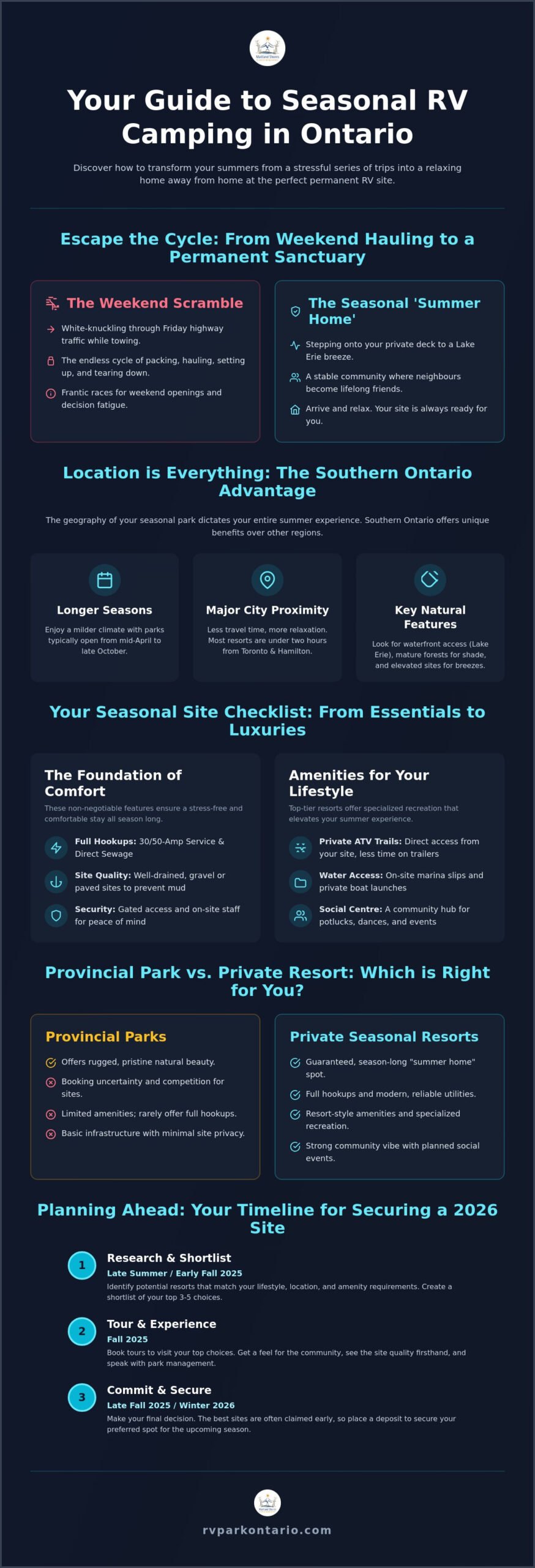
Before using this illustration: Its 2025–2026 timeline is historical, not a current application or deposit deadline. The park-type comparisons are generalizations, not promises of availability, privacy, security, utilities or recreation at a particular property. The “under two hours” travel claim has not been verified for your starting address. Compare each park’s actual agreement and selected site. At Maitland Shores, review the current seasonal dates, rates and terms and park rules; confirm site availability, boating and ATV permissions separately. Seasonal camping is recreational, not permanent residence.
Planning Your Next Season: Steps to Compare Sites
This guide was first published in 2026. For an upcoming season, ask each campground when it accepts inquiries, renewals and new seasonal applications. Starting your comparison early gives you time to review the contract and visit the park, but does not guarantee a site or priority over existing guests. At Maitland Shores, use the current rates page for season dates and confirm availability with the office.
Arrange a tour with the office before visiting. Use the park map to discuss site locations, then ask about dimensions, hookups, guest policies and approvals for site modifications. Review the seasonal rates and terms before comparing options. A map shows the layout, not a live inventory of available sites; confirm availability directly with the office.
The Site Selection Checklist
Finding the right lot requires a keen eye for detail. Your site is your sanctuary, so choose wisely. Consider these factors during your walkthrough:
- Orientation: Do you want morning sun on your deck or afternoon shade? Position your trailer to maximize your comfort.
- Location: Decide if you prefer being close to the clubhouse and pool or tucked away at the quiet edge of the park.
- Ground and drainage: Inspect the selected lot’s surface and ask the office about drainage, maintenance responsibilities and suitable placement for your RV. Follow your RV manufacturer’s setup instructions; a walkthrough cannot guarantee ground conditions throughout the season.
Budgeting for the Full Season
Compare the full seasonal cost with the number of visits you realistically expect to make. Alongside the site fee, confirm taxes, metered hydro, insurance, maintenance, storage and any separately charged activities. Include fuel and return journeys in your budget; a longer drive may affect how often you use the site. Price any proposed deck, shed or gazebo only after checking whether management will approve it and what permits are required. The guide to seasonal RV sites in Dunnville can help you prepare questions, but the current written offer and agreement should govern your comparison.
Seasonal RV Camping at Maitland Shores in Dunnville
Maitland Shores offers seasonal RV camping in Dunnville, Haldimand County, near the Grand River and Lake Erie. The park has 250+ seasonal sites; that total is not a count of vacant sites. Compare the specific lot, services and current seasonal terms with your family’s needs before choosing a summer base.
If boating or riding is part of your seasonal plans, compare those arrangements alongside the campsite itself. Read Maitland Shores’ marina information, boat launch details and ATV access information. Confirm eligibility, permissions, operating conditions and separate fees with the office. A seasonal campsite does not by itself establish hunting permission, a reserved boat slip or unrestricted trail access.
Plan local outings from your seasonal base
Think about how you would spend repeat visits, including days when you do not want to tow or move the RV. Use the Dunnville and Lake Erie outing guide to compare waterfront stops, heritage visits and other nearby options. Check each destination’s current opening dates, access conditions and parking arrangements before setting out. Plan transport from your campsite separately, particularly if your motorhome is your only vehicle.
Your Gateway to Dunnville and Beyond
Maitland Shores offers seasonal RV camping in Dunnville, Haldimand County, with a camping season of April 15 to October 31. Confirm current site availability, dimensions and hookups directly with the office. Use current map directions and traffic information when travelling from Toronto, Hamilton or other communities.
Secure Your Slice of Lake Erie Paradise
Bring your comparison back to practical choices: Can the lot accommodate your setup? Will you use it often enough to justify the full seasonal cost? Do the operating dates, visitor rules and activity permissions fit your plans? Compare the written offer with your expected use and take unresolved questions to the office before paying a deposit. A tour or inquiry is a planning step, not confirmation that a particular site is reserved.
Maitland Shores is in Dunnville, Haldimand County, near Lake Erie. Before choosing a seasonal site, review the camping options and confirm the services available at the specific lot. Travelling from the GTA? Use the Toronto-to-Dunnville camping guide to plan your route and arrival. Travel time varies with your departure point, traffic and towing requirements; do not rely on a fixed 90-minute estimate.
Planning a future season? Review the current seasonal rates and terms, then contact Maitland Shores about site availability and a tour. Confirm the season dates, site dimensions, hookups, total charges and deposit requirements before committing. An inquiry or tour request does not reserve a site.
Frequently Asked Questions
What is the typical season length for seasonal campgrounds in Ontario?
Season dates vary by campground and year. Maitland Shores’ current rates page lists April 15 to October 31 for the 2027 seasonal camping season. Review the current seasonal terms and confirm arrival arrangements with the office. Do not assume another private or provincial park follows the same dates.
Can I leave my RV on the site during the winter months?
Some campgrounds offer winter RV storage, subject to their contract and access rules. Storage is not permission for winter camping or year-round residence. At Maitland Shores, check the current seasonal terms and confirm storage arrangements and winterization responsibilities with the office. The park is closed outside April 15–October 31 unless management grants prior written authorization for access. Ask separately about boat storage.
Are dogs allowed at seasonal RV resorts in Ontario?
Pet policies differ between campgrounds, so check the rules before choosing a site. At Maitland Shores, dogs are permitted at campsites subject to leash requirements and restrictions on common areas. Review the current pet rules, including permitted numbers and excluded areas, and confirm any needs with the office. Do not assume another resort has the same policy.
What is included in a seasonal camping fee?
Inclusions vary by campground and site. At Maitland Shores, review the current seasonal rates and terms and confirm water, sewer, metered hydro, taxes, insurance requirements and any additional charges with the office. Do not assume a campsite fee includes a marina slip, boat launch use or boat storage; ask about each boating service separately.
Do I need special insurance for a seasonal RV site?
Insurance requirements depend on the campground’s agreement and your circumstances. For Maitland Shores, review the current occupant insurance requirements and ask the office what proof must be provided and when. Share the park’s requirements and your intended seasonal use with your insurer to confirm suitable coverage; do not assume a campsite fee or the park’s insurance covers your RV and belongings.
Can I build a deck or a shed on my seasonal campsite?
Do not assume that a private seasonal site includes permission to build a deck or shed. Before buying materials or arranging work, ask whether the proposed structure is permitted and obtain written management approval and any required permits. At Maitland Shores, review the site-improvement and permit rules for size, placement and other conditions. A seasonal site agreement is not land ownership or unrestricted alteration permission.
How do I find a seasonal site with boat launch access?
Check the campground’s boating information rather than assuming all waterfront sites include boating access. For Maitland Shores, review the marina information and boat launch details. Confirm launch access, slip availability, fees, boat and trailer parking, and suitability for your vessel directly with the office. Check current water and weather conditions before heading out.
Is seasonal camping cheaper than owning a cottage in Ontario?
The answer depends on your purchase price, ongoing fees and how you use the property or RV. Compare the RV purchase or financing cost, seasonal site fees, taxes, metered utilities, insurance, maintenance, storage and travel with the full cost of a cottage. Review any trailer purchase options separately from the seasonal site agreement. A seasonal campsite is not a substitute for year-round residential accommodation.