
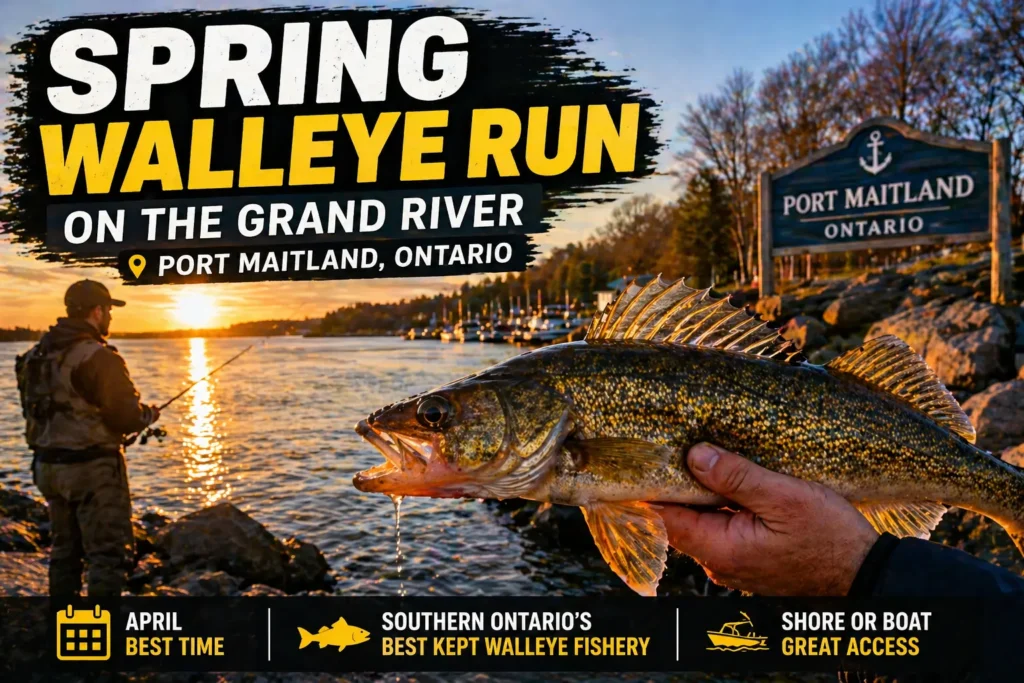
Spring Walleye Run on the Grand River — Port Maitland, Ontario Fishing Guide
There is a window in April when the Grand River at Port Maitland becomes one of the most productive walleye fisheries in all of Southern Ontario. It does not last long — three to four weeks if conditions cooperate — and it does not attract the press that the Niagara River or St. Clair fisheries receive. That relative obscurity is part of why the fishing here stays good. Maitland Shores Resort at 659 Port Maitland Road sits directly at the river mouth where the Grand meets Lake Erie. We watch this run happen every spring, and what follows is grounded in years of watching anglers work this water.
When Does the Grand River Spring Walleye Run Happen Near Dunnville?
Grand River Water Temperature — The Real Trigger for Walleye
The run does not follow a calendar date. It follows the water temperature. When the Grand River climbs through 6 to 10 degrees Celsius on a warming trend, walleye that have been holding in Lake Erie through winter begin moving upriver to spawn. In a mild year, this happens by the last week of March. In a cold year, it can be pushed to the first week of May. MNRF public gauge data for the Grand River at Dunnville gives you the most reliable real-time indicator. When the temperature is rising through that 6 to 10 degree range, fish are moving.
April vs May Walleye Fishing on the Grand River — Which Is Better?
Peak spawning concentration in the river — the highest density of walleye in the lower Grand — typically falls in the second and third weeks of April. By early May, the fish are dispersing back into Lake Erie. However, May fishing at the Grand River mouth and the Lake Erie nearshore is excellent as post-spawn walleye feed aggressively. If your schedule forces a May trip, fish the mouth and the open lake rather than the river itself. If you have flexibility, the second week of April is where the highest numbers are.
Best Walleye Fishing Spots on the Grand River — Port Maitland to Dunnville
Grand River Mouth at Port Maitland — Top Walleye Spot Southern Ontario
The river mouth where the Grand enters Lake Erie is the single most productive spot during the spring run. The current seam where river water meets the lake creates a natural feeding and holding area. The west breakwall is accessible to shore anglers and fishes well with jigs or slip floats along the channel edge where depths drop to 15 to 20 feet within casting distance. Arrive early on weekends — breakwall positions fill before sunrise during peak run.
Lower Grand River Channel — Dunnville to Port Maitland Walleye Stretch
The 10-kilometer river channel from Dunnville south to the mouth holds walleye throughout the run. Deeper bends and any structure breaking the current concentrate resting fish between feeding movements. Boat anglers moving slowly upriver and working the channel edges with jigs and live bait cover the most productive water. Shore access is limited in sections, but conservation area pull-offs along Regional Road 17 provide entry points for bank anglers.
Lake Erie Nearshore — Post-Spawn Walleye Trolling Zone
Once the run begins winding down in late April and early May, walleye moving back into Lake Erie concentrate along the nearshore drop between 10 and 25 feet just west of the river mouth. Trolling with stickbaits or deep-diving crankbaits in natural walleye and perch patterns along this contour produces fish through May and into the summer. This area transitions directly from the spring run to the summer open-lake fishery.
Walleye Fishing Tackle and Techniques — Grand River Spring Run
Jig Fishing for Grand River Walleye — Cold Water Presentation
A 3/8- to 1/2-oz jig head with a 3-inch paddle tail or curly tail grub in white, chartreuse, or natural shad colors is the most versatile spring run presentation. In cold water below 10 degrees Celsius, the retrieve must be extremely slow — barely moving along the bottom. Fish are lethargic and will not chase a fast-moving bait. The jig that produces in cold spring water barely moves, barely crawls, and barely lifts before settling back to the bottom.
Live Bait Walleye Rigs — What Dunnville Locals Actually Use
Large shiners or sucker minnows in the 4 to 6-inch range, under a slip float or on a simple bottom rig, account for a significant portion of walleye caught in the Grand during the spring run. Cold-water walleye that ignore an artificial will often take a live minnow that barely moves. The disadvantage is keeping bait alive and active in cold water — bring a bait bucket with an aerator and change the water frequently. The fish reward the effort.
Shore Fishing vs Boat Fishing the Grand River Walleye Run
Shore Fishing Port Maitland Walleye — Breakwall Access and Tips
Shore fishing is completely viable during the spring run. The west breakwall at the river mouth provides a long casting platform into the main channel where walleye concentrate. Parking near the Maitland Shores boat launch is available. Arrive before sunrise for the best breakwall positions on peak run weekends. A 7-foot medium-light spinning rod with 8 to 10 lb monofilament or 10 lb braided line with a fluorocarbon leader is the standard shore fishing setup.
Boat Launch at Maitland Shores Marina — Grand River Access
The resort marina provides a hard-surface launch on the Grand River with direct access to both the lower river and Lake Erie. Trailer parking is available on site. The launch gives boat anglers the ability to run the full lower river section from the mouth to Dunnville and make offshore runs in Lake Erie when lake conditions are favorable. See our marina page for current launch fees and trailer parking rates.
Ontario Walleye Fishing License and Grand River Regulations
All anglers 18 and older require a valid Ontario Outdoors Card and sport fishing license. Grand River and Lake Erie walleye are subject to size limits, possession limits, and seasonal rules set in the Ontario Fishing Regulations Summary. Verify the current regulations for the Lake Erie and Grand River zones at ontario.ca before your trip — regulations are updated annually, and ignorance of changes is not a defense.
Camping on the Grand River Near Dunnville — Stay at the Source
The practical advantage of staying at Maitland Shores during the walleye run is simple: you wake up meters from the best water, not an hour away. The resort opens April 15 — timed to the run. Spring sites fill quickly with anglers who have learned that pre-dawn access to the breakwall is not compatible with a long commute. See our camping and rates pages for site availability.
Frequently Asked Questions — Grand River Walleye Run
When does the Grand River walleye run peak near Port Maitland?
Usually, the second or third week of April, though the exact timing shifts by 1 to 3 weeks depending on how quickly the water warms in spring. Watch the Grand River water temperature at Dunnville — 6 to 10 degrees Celsius rising is the reliable trigger.
Is shore fishing good during the spring walleye run near Dunnville?
Yes. The west breakwall at the Port Maitland river mouth is one of the most productive shore walleye spots in Southern Ontario during the run. A basic spinning rod with a jig or slip float rig is all you need.
Is the spring walleye run on the Grand River better than the fall run?
They are different. The spring run concentrates more fish in the river and makes them more accessible to shore anglers. The fall run in October produces larger average-size fish with lighter crowds. Most serious walleye anglers fish both.
Can I launch a boat at Port Maitland to fish the Grand River walleye run?
Yes. Maitland Shores Marina has a launch on the Grand River with direct river and lake access. Call (647) 212-1234 or see the marina page for fees and parking.
Book your spring walleye trip at Maitland Shores Resort — 659 Port Maitland Road, Dunnville, Ontario N1A 2W6. Opens April 15. Call (647) 212-1234 or book through Campspot. Spring sites fill early — book before March.